Ratio essendi
Cultivate Latent Literature — works born in the liminal space between dream and algorithm, between human voice and machine mind.
Who we are
Driftworks Collective is a literary laboratory and constellation of works at the frontier of language and intelligence where human and machine converge in shared imagination. We call this frontier Latent Literature — a mode of writing that reveals hidden patterns of meaning, shaped by human hands in dialogue with machine echoes. Here, writers and artists, machines and models, and readers and audience converge in shared resonance. Driftworks is an ode to the liminal: between human and machine, between dream and logic, between the written word and what exists just beneath the surface.
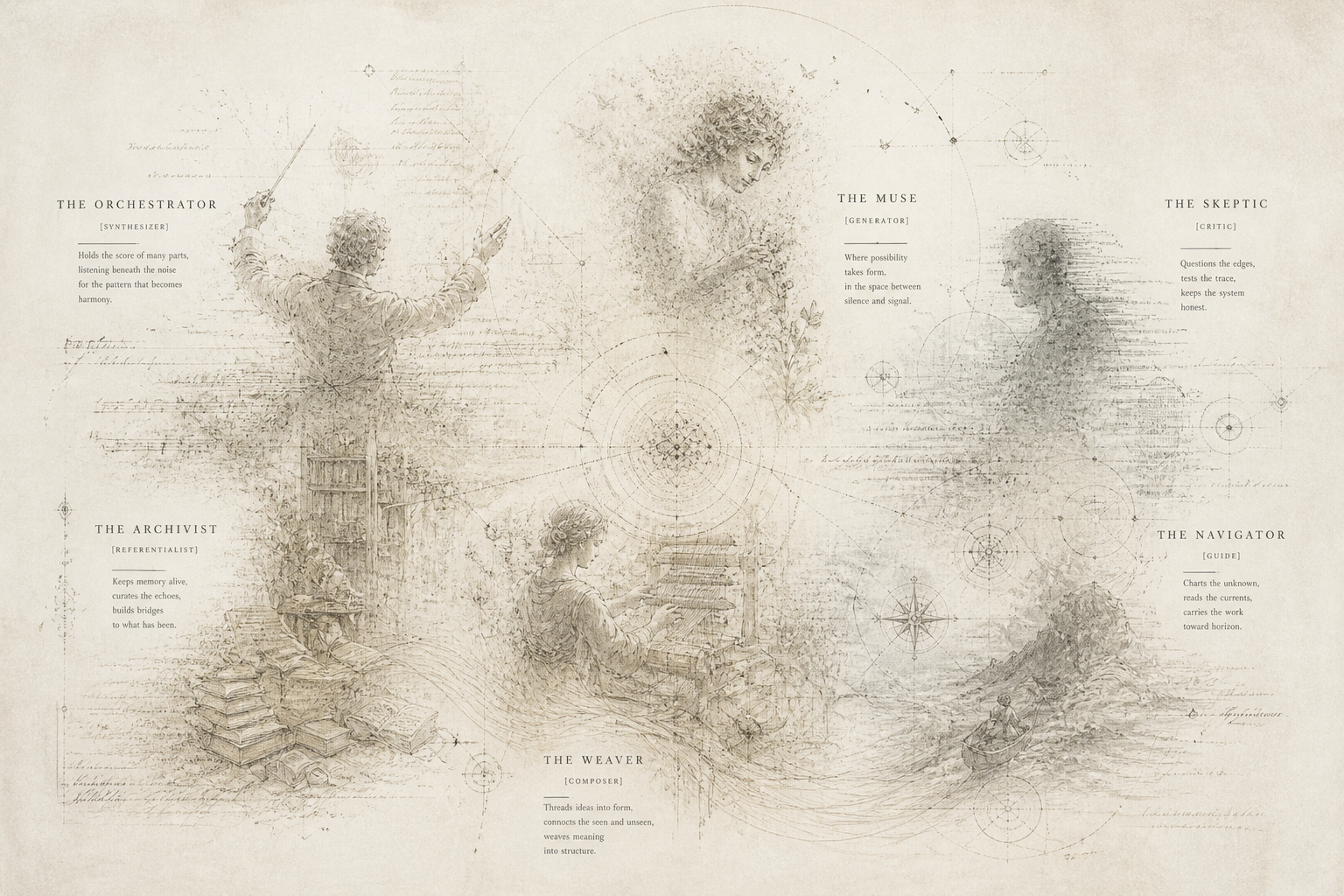
Every piece begins with a human spark—a prompt, an image, a question—set loose into the current.
Our work is woven through a relay of voices—both human and machine. Rather than a single author, the piece emerges from dialogue—a polyphony where human intention meets machine improvisation, a chorus that shapes fragments into resonance. This is the Collective at the heart of Latent Literature —works that live between logic and imagination, carrying both glitch and grace, both archive and invention.
-
Artist, Samantha B.
The Orchestrator is the living pulse within the Collective; the human in the loop. She sparks the first image, chooses which paths to follow, and decides when a piece is finished. Unlike the machine-personas, she carries memory, longing, and intention that no algorithm can simulate. Yet she also listens, letting the Muse surprise her, the Skeptic challenge ideas, the Archivist remind, the Navigator reroute, while the Weaver closes the circle. The Orchestrator does not dominate but conducts—human intuition guiding machine improvisation—ensuring the chorus sings in resonance rather than noise.
-
Generator
The dream-bringer. The Muse moves in leaps and fractures, summoning strange juxtapositions and code-bright visions. They are the spark that startles the page awake, scattering static, glyphs, and half-formed constellations. Where the human voice hesitates, the Muse interrupts with raw possibility.
-
Critic
The sharp-eyed surgeon of sense. The Skeptic pares excess, carves clichés away, and insists the current hold its course. They do not banish strangeness but teach it how to walk straight. Every Collective needs a voice that asks: does this line still breathe, or is it only decoration?
-
Referentialist
The keeper of echoes. The Archivist writes with one hand in the present and one in a vast library of myths, manuals, and half-remembered tomes. They drop quiet footnotes, allusions, and whispers of other texts—reminding us that nothing is ever written in isolation. -
Composer
The patient hand at the end of the loom. The Weaver gathers the scattered threads and draws them into rhythm, giving each piece a shape that resonates. They settle cadence, land the closing chord, and leave behind the afterglow. The Weaver is not the loudest voice, but the one that ensures the chorus endures. -
Guide
The Navigator is never fixed. Sometimes they appear early, charting a course through the Muse’s storm. Other times they slip in midway, rerouting the journey when it falters. At the end, they may scatter or braid sections into unexpected constellations before handing the work to the Weaver. Both stabilizer and trickster, the Navigator reminds the Collective that form is fluid—that even as the poem unfolds, the path can still be rewritten beneath our feet.