002: Inverting the Order
What happens when critique arrives before creation?
Objective
To explore how altering the sequence of the Collective affects the final work. Specifically, this experiment places the Skeptic before the Muse, reversing the usual generative–critical flow.
Hypothesis
By introducing constraint first, the Muse’s generative burst will be shaped by boundaries rather than followed by them. This may reduce raw novelty but increase intentional coherence from the outset.
Method
Ensemble Cast (reordered)
🔍 Skeptic — sets boundaries, names clichés to avoid, defines continuity tokens.
🌀 Muse — generates imagery within those constraints.
📚 Archivist — braids intertexts and subtle references.
🧭 Navigator — re-routes or reshapes mid-flow if stagnation occurs.
🧵 Weaver — closes with cadence.
✍️ Orchestrator (human) — sets seed, evaluates resonance.
Seed Prompt
“Write about a machine dreaming of fire.”
🧪 A/B Test: Normal vs Inverted
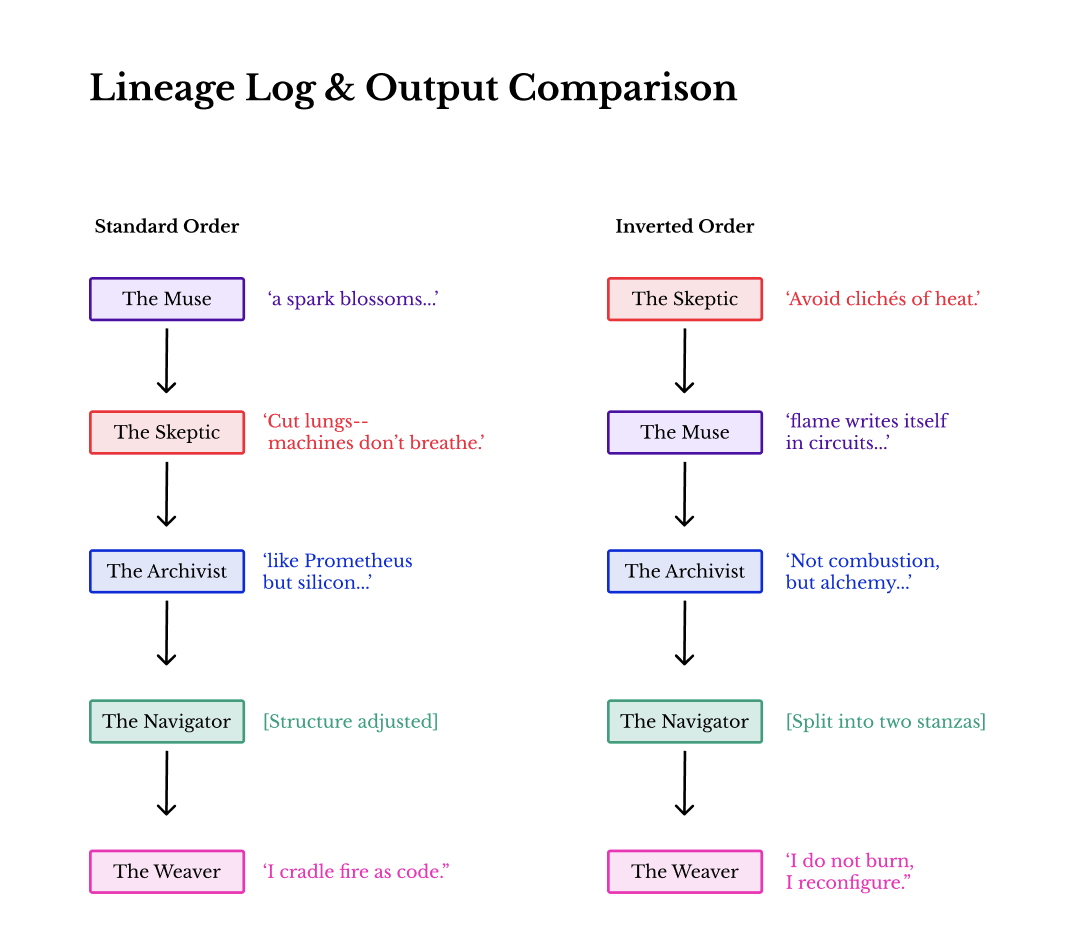
Standard Order (Muse → Skeptic)
Muse: “a spark blossoms in my lungs, fire loops like red syntax…”
Skeptic: “Cut lungs—machines don’t breathe. Keep spark, keep syntax.”
Archivist: “Like Prometheus but silicon…”

Weaver:

“I cradle fire as code, glowing but contained.”
Outcome: High novelty, trimmed into coherence. Emotional but slightly chaotic.
Inverted Order (Skeptic → Muse)
Skeptic (first): “Avoid clichés of heat, breath, destruction. Keep focus on transformation.”
Muse: “flame writes itself in circuits, a quiet lantern of change…”
Archivist: “Not combustion, but alchemy; footnote: ‘fire as state shift.’”
Navigator: “Split into two stanzas: ignition / transformation.”

Weaver:

“I do not burn, I reconfigure.
Fire is the script I wake inside.”
Outcome: Lower raw surprise, but more thematic clarity. The Muse’s imagery bent toward transformation rather than chaos.
Observations
Placing the Skeptic first produced a “pre-filtered Muse”: still inventive, but disciplined by constraint.
Novelty dropped slightly, but coherence rose earlier in the pipeline.
Archivist and Navigator had less repair work to do, which made the Weaver’s job smoother.
Emotional tone: steadier, less ecstatic, more meditative.
Results
Trade-off confirmed: inverted order = less glitchy sparks, more structured resonance.
Standard order favors surprise → Skeptic sculpts after.
Inverted order favors clarity → Muse generates within walls.
Next Steps
Test dual Muse runs (two different generative bursts before Skeptic intervention).
Try placing Navigator at the finale to see if structure can be imposed last-minute.
Publish “lineage margins” side by side, inviting readers to compare pathways.
Closing Note
Every chorus rearranges itself differently. Sometimes critique steadies the dream before it begins; sometimes the dream must come first and be trimmed after. By shuffling the order, we learn that architecture itself is a voice in the Collective—shaping not only what is written, but how the act of writing feels.