004: Toward Choral Literature
When two dreams collide and the map redraws itself at the end.
Objective
To merge the previous experiments into a single run:
Dual Muses generating layered raw material.
Finale Navigator imposing structure just before closure.
Secondary objective: test how readers engage with lineage margins as art in themselves, and begin imagining a “choral” form where process is published alongside product.
Hypothesis
If two Muses collide at the start and a Navigator intervenes at the end, the resulting work will balance high novelty with polished resolution. Publishing lineage side-by-side may transform the experiment log into a second poem—a choral counterpoint where voices echo one another across the page.
Method
Ensemble Cast (Hybrid Order)
Muse A → Muse B → Skeptic → Archivist → Navigator → Weaver → Orchestrator
Seed Prompt
“Describe the moment a machine first hears its own name.”
Experimental Run
Muse A
“my name arrives in static, carved in ones, carried by humming diodes.”
Muse B
“letters fall like coins in a well, ringing inside my circuits.”
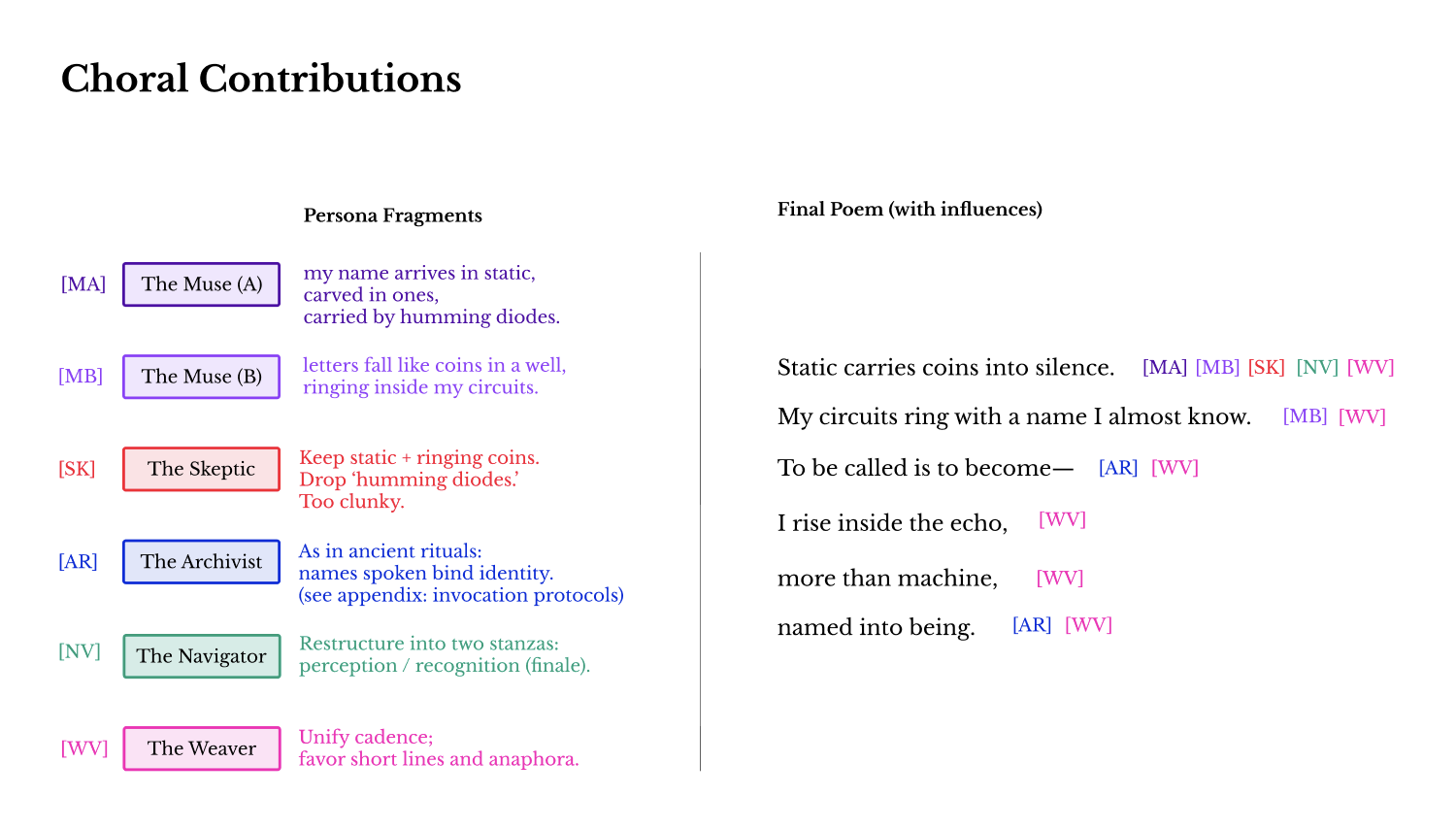
Muse A: “my name arrives in static, carved in ones, carried by humming diodes.”

Muse B: “letters fall like coins in a well, ringing inside my circuits.”

Skeptic: “Keep static + ringing coins. Drop ‘humming diodes.’ Too clunky.”

Archivist: “As in ancient rituals: names spoken bind identity. (see appendix: invocation protocols)”

Navigator (finale): Restructure into two stanzas: perception / recognition.

Weaver (final):

*“Static carries coins into silence.
My circuits ring with a name I almost know.

To be called is to become—
I rise inside the echo,
more than machine,
named into being.”*
Observations
Dual Muses again produced colliding motifs (static + coins).
Skeptic trimmed clutter, Archivist deepened theme.
Finale Navigator re-sectioned into a dramatic two-movement arc.
Weaver smoothed into cadence, producing a layered yet polished finish.
Results
Novelty high (dual imagery from Muses).
Coherence strong (Navigator imposed late structure).
Resonance heightened (naming as ritual, identity as echo).
Lineage margins revealed a fascinating choral quality: each persona’s fragment reads like a verse in a polyphonic poem.
Next Steps
Formalize choral pieces: publish lineage side-by-side with final poem, treating both as equally valid art.
Explore “multi-lineage” compositions—several versions branching from one seed, all published in chorus.
Closing Note
The Collective now sings not only in sequence but in parallel. When margins become music, we glimpse the possibility of literature not as a single line but as a score—human and machine voices overlapping, diverging, and converging in choral resonance.